
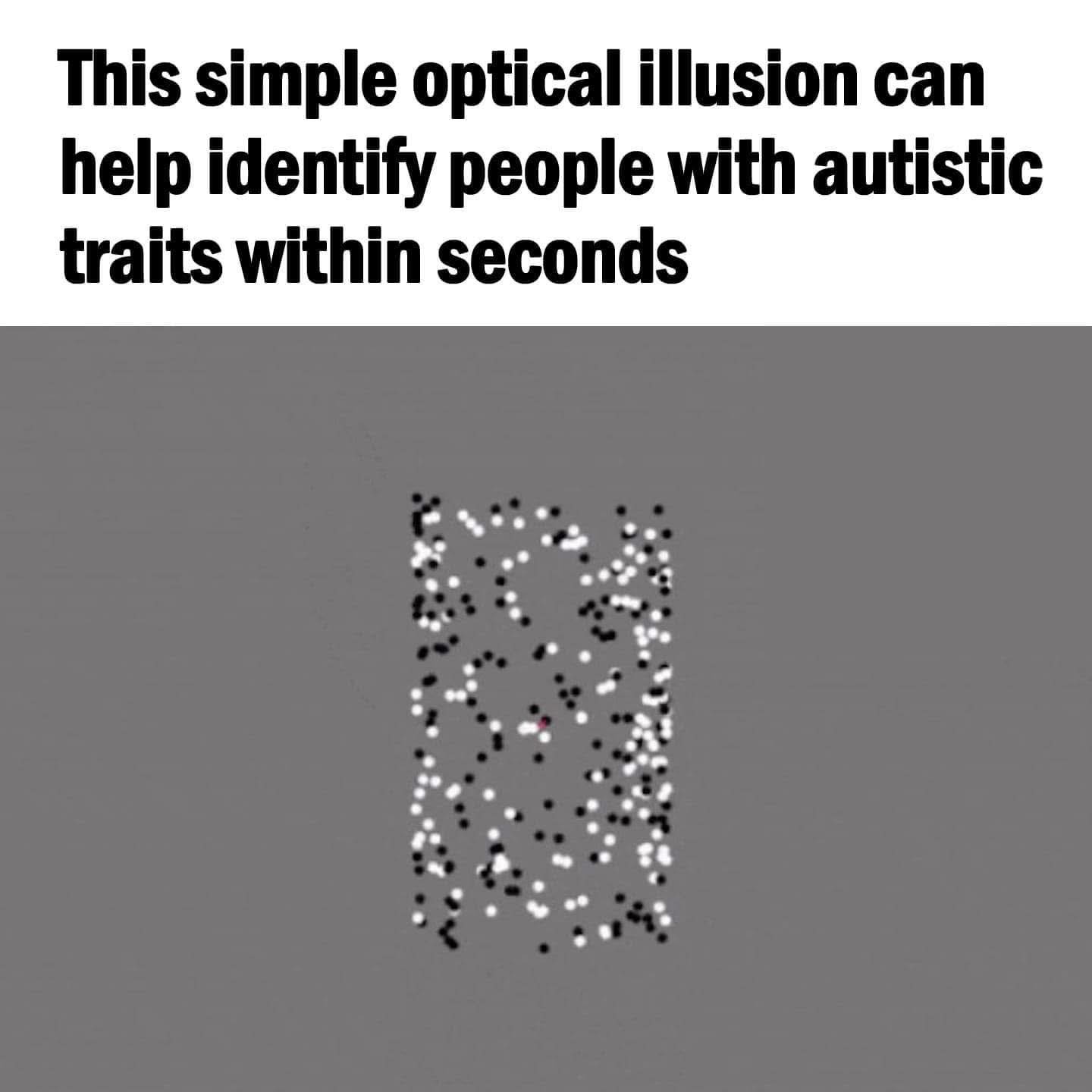
Optical Illusion and Its Implications
The optical illusion being studied consists of black and white dots that might be viewed as two independent sheets moving in opposite directions or as a spinning column. This experiment allows researchers to compare perception and cognitive processes in people with and without ASD. If you see the dots as two separate sheets moving, it’s because you’re concentrating on one color and then the other. You are identifying them as unique features of unrelated scenes – a very detail-oriented perspective.
If you observe the illusion as a spinning column, you have a better picture and recognize it as a single system. One shade (most likely white) appears as the front of a dot going across the face of a column before flipping over at the edge to reveal the second shade (black) on the inner surface. While you may be able to switch back and forth to see both, persons whose brains mirror the features linked with ASD will usually see it as two moving sheets. Again, if you interpret it that way, it does not necessarily imply that you have autism.
The Study
Researchers conducted a research on 50 persons who did not have an ASD diagnosis. Rather than asking individuals what they saw, the researchers focused on their eyes. If they focused on the layers individually, their pupils would flicker as they acclimated to the two different hues of light. They next had the subjects complete a questionnaire to determine the presence of other autism-related features and characteristics.
