
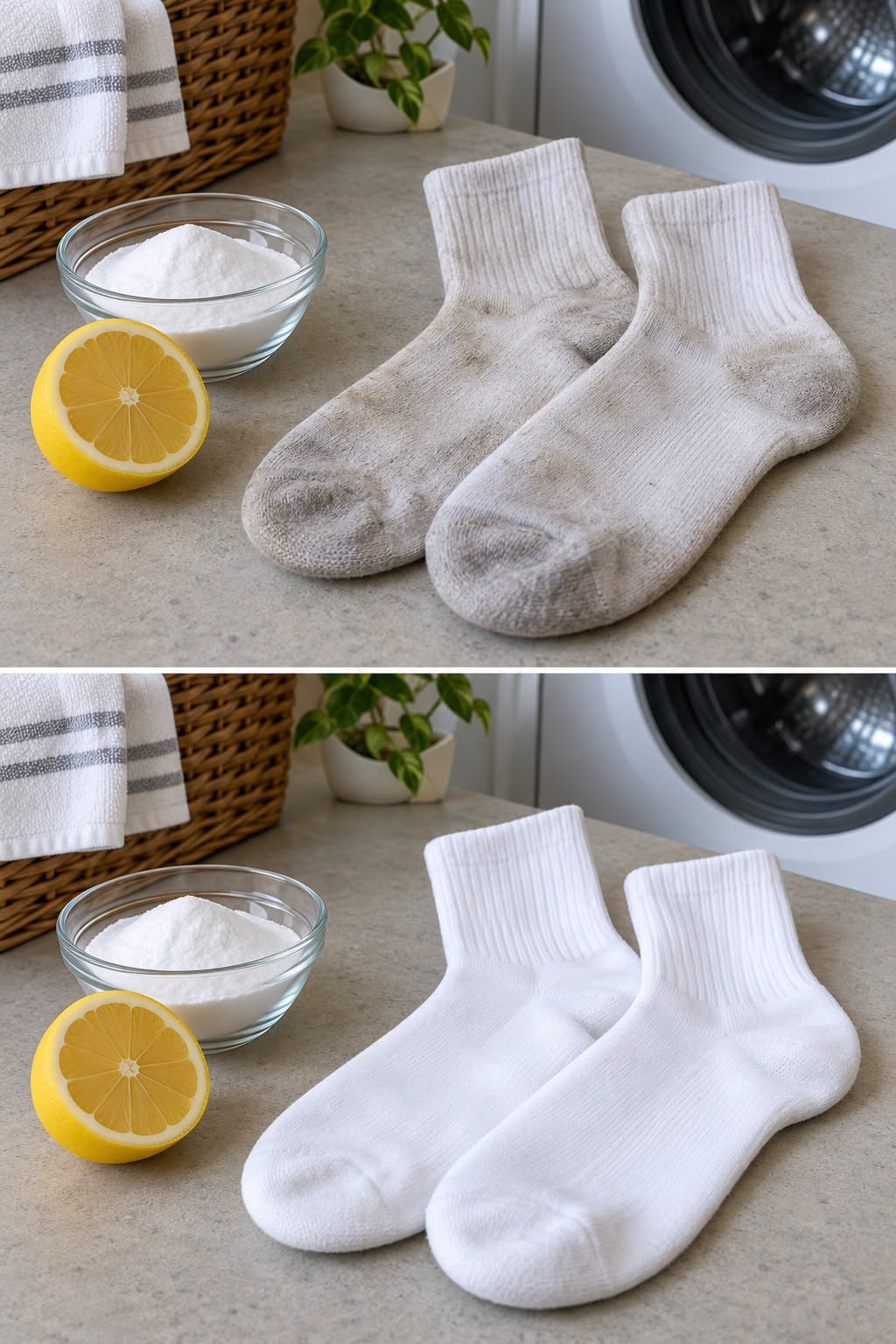
Have you ever washed your socks, dried them, and put them away, only to discover that they still smell unpleasant the next time you wear them? 😩 You’re not alone!
Socks absorb sweat, moisture, and oils throughout the day. When these combine with bacteria naturally found on the skin, they can create stubborn odors that ordinary washing doesn’t always remove completely.
You might have tried stronger detergents, fabric softeners, scented laundry boosters, and expensive cleaning products without getting the results you wanted. But before spending more money, there’s a simple household ingredient worth trying: baking soda! 🧂
This inexpensive powder can help neutralize odors and loosen some types of dirt when used appropriately. Although it isn’t a miracle cure, baking soda can be a useful addition to a regular laundry routine.
Let’s explore how to use it, how to tackle particularly smelly socks, and which common mistakes to avoid.
🧂 Why Does Baking Soda Help Remove Sock Odors?
Baking soda, also known as sodium bicarbonate, is a familiar household product used in cooking, cleaning, and odor control.
Its mildly alkaline properties can help neutralize certain acidic odors. It can also assist with cleaning when combined with water and an appropriate detergent.
Here are a few reasons it may be helpful for smelly socks:
- 🌬️ Helps control odors: Baking soda can neutralize some unpleasant smells rather than simply covering them with perfume.
- 🧼 Supports cleaning: When used alongside laundry detergent, it may help with certain types of residue and odors.
- 💰 Affordable and easy to find: Most supermarkets sell it at a relatively low cost.
- 🧺 Useful for laundry maintenance: It can be an occasional addition to a compatible laundry routine.
However, baking soda is not a reliable disinfectant and does not kill every odor-causing microorganism. It also cannot replace proper washing and drying.
🧦 1. How to Use Baking Soda to Freshen Smelly Socks
If your socks have a lingering odor, start with a simple method that doesn’t require expensive products.
What You’ll Need
- 🧂 1–2 tablespoons of baking soda
- 💧 A basin of lukewarm water
- 🧺 Your usual laundry detergent
- 🧤 A clean towel or drying rack
Step-by-Step Instructions
Step 1: Prepare the water. Fill a basin with enough lukewarm water to cover the socks.
Step 2: Add the baking soda. Dissolve 1–2 tablespoons in the water and stir until distributed.
Step 3: Soak the socks. Leave them for approximately 30 minutes. For stubborn odors, a longer soak may be appropriate if the fabric care label permits it.
Step 4: Wash as usual. Wash the socks with a suitable laundry detergent, following the care instructions and recommended water temperature.
Step 5: Dry them completely. Air-dry the socks in a well-ventilated area or use a dryer if the care label allows it.
✨ The key to fresh-smelling socks is thorough washing and complete drying. Baking soda may help, but it cannot compensate for socks that remain damp or haven’t been properly cleaned.
🍋 2. Can Lemon Juice Make Socks Whiter and Fresher?
Lemon juice is sometimes recommended as a natural laundry aid because its acidity may help loosen certain stains. However, it is not a guaranteed disinfectant or fabric whitener, and it can affect delicate or colored fabrics.
If you want to try it, use caution.
A Cautious Lemon Cleaning Method
- 💧 Dampen a washable, light-colored cotton sock with water.
- 🍋 Test a small amount of diluted lemon juice on a hidden area first.
- ⏱️ If the fabric shows no discoloration or damage, apply the diluted mixture briefly to the stained area.
- 🧼 Wash the sock thoroughly with laundry detergent.
- 🌬️ Allow it to dry completely.
Avoid using lemon juice on delicate fabrics, wool, silk, or colored socks without checking the care instructions. Do not combine lemon juice with bleach or other cleaning chemicals.
A better everyday option: For most socks, a suitable detergent, the recommended wash temperature, and complete drying are more reliable than homemade lemon mixtures.
🧺 3. How to Use Baking Soda in the Washing Machine
Baking soda can be used in some laundry routines, but it’s important to check your washing machine’s manual before adding it.
If your machine’s manufacturer permits it, a small amount may help with certain odors.
Here’s What to Do
- Separate white, colored, and delicate socks according to their care labels.
- Avoid overloading the washing machine so water and detergent can circulate properly.
- Measure your usual laundry detergent according to the product instructions.
- If permitted, add a small amount of baking soda using the method recommended by the machine manufacturer.
- Select a suitable washing program and temperature.
- Remove the socks promptly after the cycle finishes and dry them thoroughly.
⚠️ Important: Do not assume that baking soda prevents limescale or protects every washing machine. It is not a substitute for a manufacturer-approved washing-machine cleaner or descaling product.
Also, avoid adding excessive amounts of any laundry additive. More product does not necessarily mean cleaner socks.
💦 4. The Best Method for Extremely Smelly Socks: Pre-Soaking
Sometimes socks develop a strong odor after a long day of walking, exercise, or working in enclosed shoes. In these cases, pre-soaking may help loosen sweat and residue before the main wash.
What You’ll Need
- 💧 Approximately 4 liters of lukewarm water
- 🧂 2–4 tablespoons of baking soda
- 🧺 Suitable laundry detergent
Instructions
1. Fill a basin. Add enough lukewarm water to cover the socks.
2. Dissolve the baking soda. Stir it into the water.
3. Soak the socks. Leave them for around 30–60 minutes, provided the fabric care instructions allow it.
4. Wash thoroughly. Put the socks through a normal wash with detergent.
5. Dry completely. Make sure there is no remaining moisture before putting them away.
For persistent odors, repeat the process if appropriate rather than immediately increasing the amount of baking soda.
You generally do not need 200 grams of baking soda for a household basin. A smaller amount is a more sensible starting point.
👟 5. Don’t Forget Your Shoes!
 Continued on the next page
