
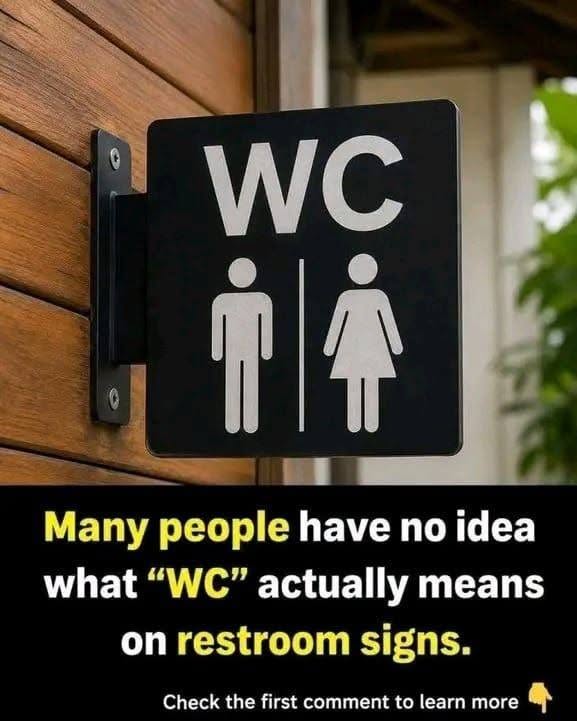
Have you ever walked into a hotel, restaurant, airport, or shopping mall and noticed a sign marked “WC”? Although millions of people see these two letters every day, not everyone knows what they actually mean.
The answer is surprisingly simple: WC stands for “Water Closet.” The expression dates back to the early days of indoor plumbing, when homes began to include small rooms equipped with a toilet and access to running water.
Today, the abbreviation remains common in many countries, particularly across Europe, even though the original expression is rarely used in everyday conversation.
What Does “Water Closet” Mean?
The term “water closet” originated when indoor plumbing became increasingly common. Before modern bathrooms were widely available, toilets were often located outside the main living areas or in separate outdoor structures.
As plumbing technology developed, toilets could be installed inside buildings. The term “water closet” came to describe a small, enclosed space containing a water-flushing toilet.
The word “closet” once referred more broadly to a small private room, rather than only a storage space as it often does today. Combined with “water,” it described a room associated with a water-flushed toilet.
Over time, the phrase was shortened to the familiar abbreviation WC, making it convenient for signs in public buildings.
Why Do So Many Countries Still Use the WC Sign?
Even though the phrase “water closet” may sound old-fashioned, the abbreviation remains widely recognized internationally.
One reason is practicality. Two letters are easy to print on signs, fit into small spaces, and can be understood by travelers who speak different languages.
In many European countries, WC is commonly used in train stations, shopping centers, restaurants, hotels, and other public places. Travelers may encounter it even when the local language has a completely different word for a toilet.
The abbreviation has therefore become a familiar international symbol for restroom facilities.
Is a WC the Same as a Bathroom?
Not always. The meaning can depend on the country and the layout of the building.
In some places, a WC refers specifically to the room containing the toilet. This room may be separate from the main bathroom, where people take showers or baths.
In other contexts, WC is simply used as a general sign for public toilet facilities.
For example, a home might have a bathroom with a bathtub, shower, sink, and toilet, as well as a separate small WC containing only a toilet and perhaps a handwashing basin.
This distinction explains why the term sometimes appears on building plans and property listings.
WC, Restroom, Toilet, or Loo: What’s the Difference?
Different English-speaking countries use different words for the same basic facilities. Although these expressions are often interchangeable in casual conversation, their preferred usage varies by region.
1. WC
Short for “water closet,” WC is frequently found on signs in Europe and other parts of the world. It is especially useful in public places where signs need to be brief and widely understood.
2. Restroom
“Restroom” is commonly used in the United States, particularly in restaurants, stores, offices, and public buildings. Despite the name, people do not necessarily go there to rest.
3. Bathroom
In American English, “bathroom” is a common everyday term for a room containing a toilet, even when there is no bathtub or shower.
In other countries, the word may more specifically suggest a room with bathing facilities.
4. Toilet
“Toilet” is widely understood internationally. In British English, people commonly use the word when asking where the facilities are located.
5. Loo
“Loo” is an informal and familiar British term for a toilet or restroom. It is often used in everyday conversation.
6. Public conveniences
This is a more formal expression sometimes found on signs in the United Kingdom. It refers to facilities available for public use.
Other Restroom Terms From Around the World
The WC abbreviation is only one example of the many ways people refer to toilet facilities.
- Loo: A common informal British English expression.
- Restroom: Frequently used in the United States.
- Bathroom: Common in American homes and everyday conversation.
- Lavatory: A more formal term that may appear in public buildings, transportation, and aviation.
- Toilet: A widely understood term in many English-speaking countries.
- Washroom: Commonly used in Canada and in some other English-speaking regions.
- Ladies and Gentlemen: Traditional signs used to identify separate facilities, although many public buildings now use gender-neutral signs.
The exact wording depends on local customs, the type of building, and whether the facilities are public or private.
Why Are Toilet Signs Often Designed With Symbols?
 Continued on the next page
